Artificial intelligence (AI) is software that can do tasks that normally need human thinking: understanding language, recognizing images, spotting patterns, making predictions and creating new content. When you ask ChatGPT, Claude or Gemini a question, filter spam out of your inbox or get a product recommendation online, you are using AI.
This guide explains what AI is in plain English, how it works, the main types you will hear about, and how small businesses actually use it today.
What is artificial intelligence?
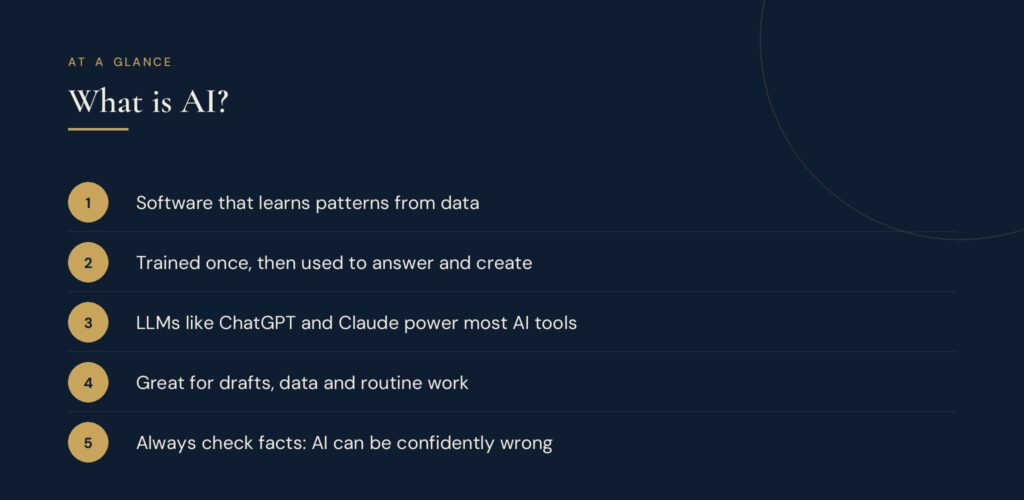
AI is a broad name for computer systems that learn from data instead of following only fixed, hand-written rules. A traditional program does exactly what a programmer tells it, step by step. An AI system is shown a large number of examples and learns the patterns itself, so it can handle situations nobody wrote a rule for.
For example, nobody can write rules for every possible spam email. But if you show an AI model millions of emails labeled “spam” and “not spam”, it learns what spam tends to look like and can judge new emails it has never seen.
How does AI work?
Most AI you use today is built with machine learning, and most modern machine learning uses neural networks: layers of simple mathematical units, loosely inspired by the brain, that adjust millions or billions of internal settings (called parameters) as they learn.
Building an AI model has two main stages:
- Training. The model studies a huge amount of data, such as text, images or sales records, and gradually adjusts its parameters until its predictions get good. Training large models takes weeks on thousands of specialized chips and costs millions of dollars.
- Inference. Once trained, the model is used to answer new questions or create new content. This is the part you interact with, and it takes seconds.
Chatbots like ChatGPT and Claude are large language models (LLMs). They are trained on enormous amounts of text to predict the next word in a sentence. Doing that well at a very large scale turns out to give them broad skills: writing, summarizing, translating, answering questions, reasoning through problems and writing code.
Key AI terms in plain English
| Term | What it means |
|---|---|
| Machine learning | Computers learning patterns from data instead of following only fixed rules |
| Neural network | A layered mathematical model that learns by adjusting millions of internal settings |
| Deep learning | Machine learning with very large, many-layered neural networks |
| Large language model (LLM) | An AI model trained on huge amounts of text to understand and generate language |
| Generative AI | AI that creates new content: text, images, video, audio or code |
| Prompt | The instruction or question you give an AI tool |
| Token | A small chunk of text (about three quarters of a word) that AI models read and write; AI APIs charge per token |
| Multimodal | A model that works with more than one type of input or output, such as text and images |
| AI agent | An AI system that can plan and take actions, such as browsing websites or using software, to complete a task |
| Hallucination | When an AI states something false with confidence |
The main types of AI
Narrow AI vs general AI
Every AI system in use today is narrow AI: it is very capable within the tasks it was trained for. Artificial general intelligence (AGI), a system that matches people across almost any task, does not exist yet. Researchers disagree on how close it is, and leading AI companies treat it as a long-term goal rather than a finished product.
Predictive AI vs generative AI
- Predictive AI analyzes data to classify or forecast: spotting fraud, scoring leads, predicting demand, recommending products or estimating delivery times.
- Generative AI creates something new: a blog draft, an image, a product video, a voiceover or a piece of code.
Most of the excitement since late 2022 has been about generative AI, starting with ChatGPT. See how we got here in our history of AI, year by year.
What AI can do for a business today
- Writing and content: first drafts of blog posts, emails, product descriptions, ad copy and social captions.
- Customer service: chatbots that answer common questions around the clock and hand complex cases to people.
- Marketing: keyword research, audience insights, ad variations, A/B test ideas and reporting summaries.
- Images and video: product photos, social graphics, short promo videos and voiceovers, often in minutes.
- Operations: summarizing meetings, extracting data from invoices and documents, and automating repetitive admin.
- Coding: building and fixing websites, scripts and integrations faster.
You can try several of these for free with our AI writing tools, including an AI blog writer, email writer and caption generator. No sign-up is needed.
What AI cannot do (yet)
- It can be confidently wrong. AI tools sometimes make up facts, figures or sources. Always check anything important.
- It does not know your business unless you give it the context: your audience, offer, tone and goals.
- It can reflect bias from the data it learned from.
- It does not replace judgment. Strategy, taste, relationships and accountability still need people.
The businesses getting the most from AI use it to speed up first drafts and routine work, then add human expertise on top.
Is AI safe to use with business data?
It depends on the tool and the plan. Many free consumer plans may use what you type to improve their models, while business and API plans usually do not by default. Before pasting customer details, contracts or financial data into any AI tool, read its privacy terms, use business-grade plans for sensitive work, and follow the data protection laws that apply to you, such as GDPR in the UK and EU.
Frequently asked questions
What is the difference between AI and machine learning?
AI is the broad goal of making computers do tasks that need human-like intelligence. Machine learning is the main method used to achieve it today: letting computers learn from data.
Is ChatGPT the same as AI?
ChatGPT is one AI product, made by OpenAI. It runs on large language models. Other popular AI assistants include Claude from Anthropic, Gemini from Google and Grok from xAI. Compare them in our guide to the best AI models in 2026.
Do I need to know coding to use AI?
No. Most AI tools work through a simple chat box. Coding helps if you want to connect AI to your own website or software through an API. See how much AI APIs cost and the best free AI APIs.
Will AI replace marketers?
AI is changing marketing work more than replacing it. It handles first drafts and data crunching quickly, but strategy, brand judgment and knowing customers still come from people who use AI well.
Put AI to work in your marketing
We help businesses use AI where it actually saves time and brings results, from content and SEO to ads and automation. Want to see where AI fits in your marketing? Request a free digital presence audit.
Sources
- Artificial intelligence (Wikipedia)
- Large language model (Wikipedia)