Many businesses do marketing every week without knowing whether it works. Posts go out, ads run, emails are sent, but nobody can say what any of it achieved. The fix is not more activity. It is clear goals and the right key performance indicators (KPIs).
This guide shows you how to set both and how to use them to make better decisions every month.
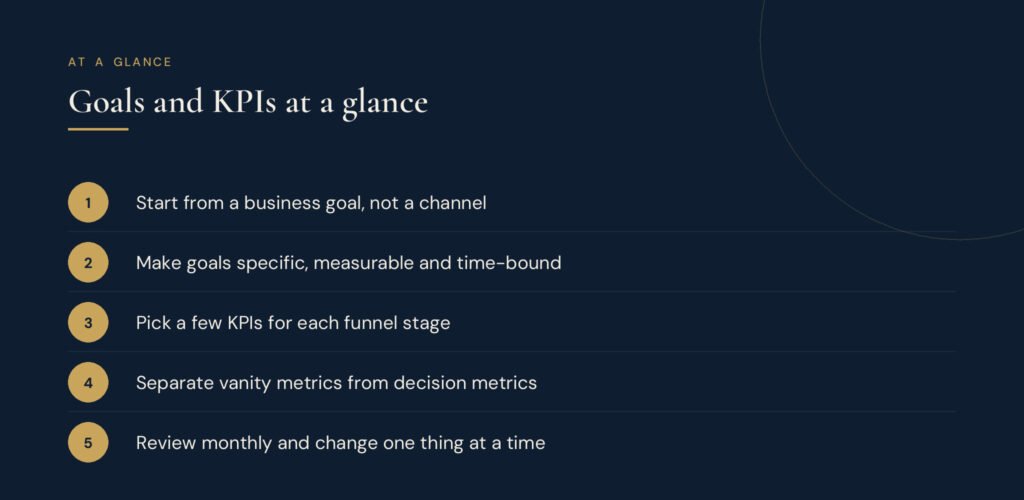
Goals versus KPIs
- A goal is the result you want, such as "win 40 new customers this quarter".
- A KPI is a number that shows whether you are on track, such as website leads, conversion rate or cost per lead.
Goals give direction. KPIs tell you if you are moving in that direction and where things are breaking down.
Step 1: Start from a business goal
Marketing goals should come from what the business needs: more revenue, more customers, more repeat purchases or entry into a new market. Avoid starting from a channel ("we need more Instagram followers") unless you can show how that channel leads to the business result.
Step 2: Make goals SMART
A useful goal is specific, measurable, achievable, relevant and time-bound.
| Vague goal | SMART goal |
|---|---|
| Get more customers | Win 40 new customers from online channels by 31 March |
| Grow on social media | Generate 60 enquiries from Instagram and LinkedIn this quarter |
| Improve the website | Raise the website enquiry rate from 1.5% to 2.5% by June |
Step 3: Choose KPIs for each stage of the funnel
People move from discovering you, to considering you, to buying. Track a small number of KPIs at each stage so you can see where the drop-off happens.
| Funnel stage | Example KPIs |
|---|---|
| Awareness | Website visitors, search impressions, reach |
| Consideration | Engaged sessions, email sign-ups, returning visitors |
| Conversion | Leads, sales, conversion rate, cost per lead |
| Retention | Repeat purchase rate, customer lifetime value, reviews |
Three to six KPIs in total is usually enough for a small business. More than that and nobody looks at them.
Step 4: Separate vanity metrics from decision metrics
Some numbers look impressive but do not tell you what to do. Likes, follower counts and page views can be useful context, but they are vanity metrics if they do not connect to enquiries or sales.
Decision metrics point to action. If your cost per lead rises, you review targeting. If your conversion rate falls, you look at the landing page. Focus your reporting on the numbers that lead to decisions.
Step 5: Set up tracking
You cannot manage what you do not measure. At minimum:
- Install analytics on your website and mark enquiries and purchases as conversions.
- Connect Google Search Console to see how people find you in search.
- Tag campaign links with UTM parameters so you know which campaign brought each visit. Our free UTM link builder makes this quick.
- Record where each new customer came from in a simple spreadsheet or CRM.
Step 6: Review monthly and act
Create a one-page monthly report with your goal, progress so far and each KPI compared with last month. Then ask three questions:
- What worked better than expected, and how can we do more of it?
- Where is the biggest drop-off in the funnel?
- What one change will we test next month?
Changing one thing at a time makes it clear what caused any improvement.
Example: a simple KPI set for a service business
- Goal: 30 new clients this quarter from online channels.
- KPIs: website visitors, enquiry conversion rate, number of enquiries, enquiry-to-client rate, cost per client.
If visitors are steady but enquiries are low, improve the website. If enquiries are high but few become clients, improve follow-up and qualification.
The bottom line
Goals tell you where you are going and KPIs tell you whether you are getting there. Keep both simple, connect them to real business results and review them every month. Over time, this habit does more for growth than any single campaign.
For a broader plan, read our digital marketing strategy for small businesses, or take the free Digital Marketing Fundamentals course, which includes a full lesson on measuring and planning.