
Most small businesses should spend between 5% and 10% of their revenue on marketing, and more while they are launching or growing fast. The right number for you depends on your stage, your margins and how quickly you need new customers.
This guide explains the common benchmarks, how to adjust them for your business, how to split the budget across channels, and the costs people forget to include.
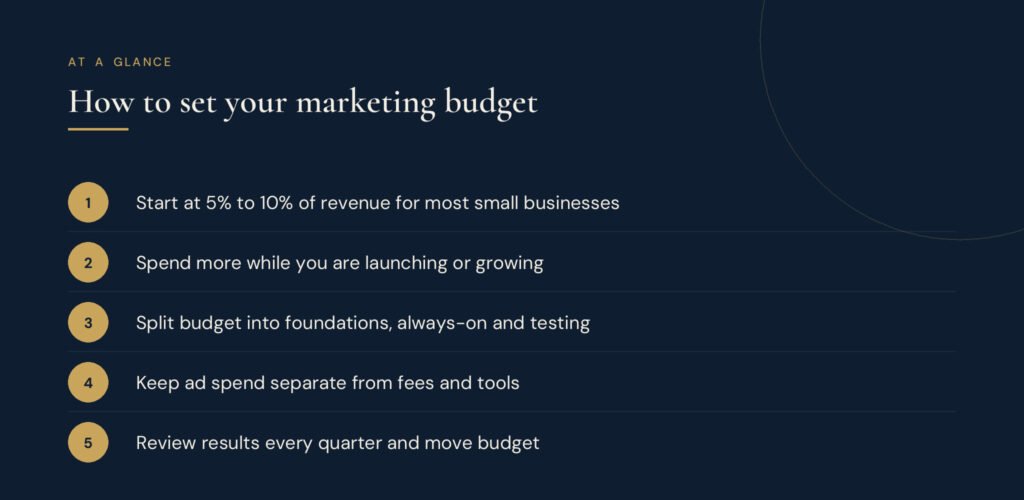
Quick answer: how much should a small business spend on marketing?
A practical starting point is 5% to 10% of revenue. Gartner's 2025 CMO Spend Survey puts the average marketing budget at 7.7% of company revenue, but that figure is based on large companies. Smaller businesses often need a higher percentage, because they are still building awareness from scratch.
| Business stage | Typical marketing budget | Why |
|---|---|---|
| Launching or pre-revenue | 10% to 20% of projected revenue | You need to build awareness and a first customer base |
| Growing small business | 7% to 10% of revenue | You are expanding into new customers, services or markets |
| Stable, established business | 4% to 7% of revenue | You are protecting market share and steady demand |
These ranges are summarized from Mercury's guide to small business marketing spend (linked below). Treat them as a starting point, not a rule.
Revenue-based budgeting: a worked example
Suppose your business brings in $400,000 a year and you are in a growth phase.
- At 8% of revenue, your annual marketing budget is $32,000.
- That is roughly $2,700 a month.
- If you plan to run paid ads, you might split it into about $1,500 for ad spend and $1,200 for content, tools and management.
If you are launching, base the percentage on the revenue you expect in your first year, then adjust every quarter once real numbers come in.
Five factors that should move your number up or down
1. Your margins
A business with high margins can afford to spend more to win each customer. If your margins are thin, focus first on low-cost channels such as search, referrals and email.
2. Customer lifetime value
If one client stays with you for years, you can spend more to win them. Work out what an average customer is worth over their lifetime, then decide what you are willing to pay to acquire one.
3. How competitive your market is
Crowded markets such as legal services, home services and real estate have higher advertising costs. You may need a larger budget, or a sharper niche, to stand out.
4. Your growth goals
Opening a new location, launching a new service or entering a new country all need extra spend for a period of time. Budget for the push, then step back down.
5. What you already have
If your website, brand and profiles are already strong, more of your budget can go into reaching people. If they are not, fix the foundations first so the traffic you pay for actually converts.
How to split your marketing budget
A simple way to divide the budget is into three buckets:
| Bucket | Share of budget | What it covers |
|---|---|---|
| Foundations | 20% to 30% | Website upkeep, branding, Google Business Profile, tools |
| Always-on channels | 50% to 60% | SEO and content, social media, email, proven ad campaigns |
| Testing | 10% to 20% | New channels, new offers and new audiences |
The testing bucket matters. It is how you find the next channel that works, without putting your whole budget at risk.
Costs people forget to include
- Ad spend versus management fees. The money paid to Google or Meta is separate from what an agency or freelancer charges to run the campaigns.
- Software. Scheduling tools, email platforms, design apps and analytics often cost $50 to $300 a month combined.
- Content production. Photography, video and copywriting add up quickly.
- Website maintenance. Hosting, security, updates and fixes are ongoing costs, not one-off ones.
- Your own time. If you do marketing yourself, those hours have a real cost too.
How to know if your budget is working
Track a few numbers every month rather than everything at once:
- Leads or enquiries from each channel.
- Cost per lead, which is total spend on a channel divided by the leads it produced.
- Conversion rate from lead to paying customer.
- Customer acquisition cost, the total marketing cost divided by new customers won.
- Return on spend, revenue from marketing compared with what it cost.
Review the numbers every quarter. Move money away from channels that do not produce leads, and toward the ones that do.
Frequently asked questions
Is 10% of revenue too much to spend on marketing?
Not if you are launching or growing and the spend is producing customers. For a stable business with steady demand, 4% to 7% is often enough.
Should a new business spend more on marketing?
Usually, yes. New businesses have no existing reputation or customer base, so they often spend 10% to 20% of projected revenue in the first year to build both.
Does the marketing budget include ad spend?
It should. Your total marketing budget includes ad spend, agency or freelance fees, tools and content. Keep ad spend as its own line so you can see what each part costs.
What if I cannot afford 5% of revenue?
Start with the channels that cost time rather than money: a complete Google Business Profile, a clear website, consistent social profiles and asking happy customers for reviews.
Build a budget that works for your business
Our digital strategy and presence management service turns your goals into a clear plan and budget across your website, search, social media and ads. Not sure where your money should go first? Request a free digital presence audit, or read our guide to digital marketing packages and pricing.