SEO usually takes three to six months to show early results and six to twelve months to deliver steady, meaningful traffic. Some pages rank faster, and some never rank at all without improvement.
This guide explains what the research shows, a realistic month-by-month timeline, the factors that speed SEO up or slow it down, and what to do while you wait.
What the data says about SEO timelines
Google itself has said that in most cases SEO needs four months to a year to implement improvements and see a potential benefit, according to a Google video by Maile Ohye cited by Semrush.
Ahrefs' study of how long it takes to rank adds detail:
| Finding | Result |
|---|---|
| Average age of the page ranking #1 | About 5 years |
| Top-10 pages that are more than 3 years old | 72.9% |
| Top-10 pages that are less than 1 year old | 13.7% |
| New English pages that reached the top 10 within a year | 6.11% |
| Pages that reached the top 10 within their first month | 40.82% of those that made it |
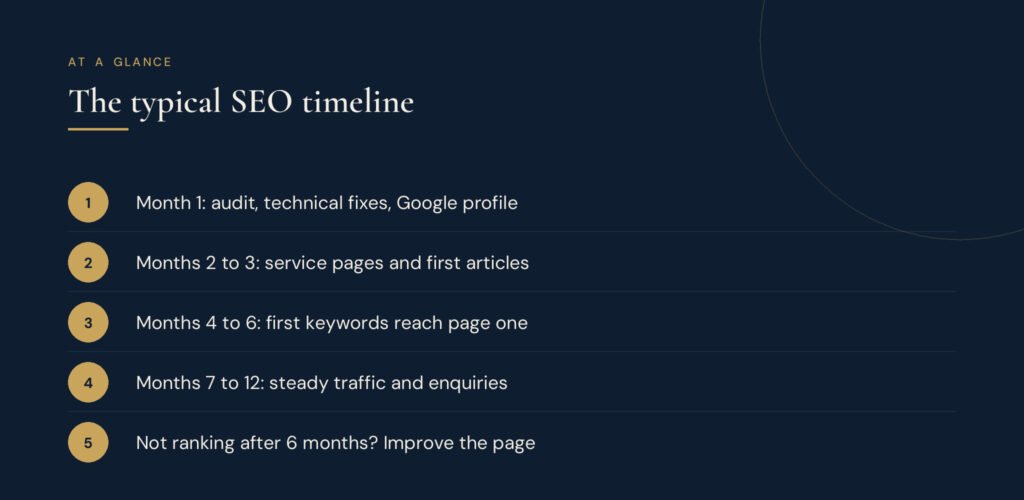
The lesson is not that new pages cannot rank. It is that ranking well usually takes months of consistent work, and pages that are not ranking after about six months should be improved rather than left alone.
A realistic SEO timeline for a small business
| Period | What happens | What you should see |
|---|---|---|
| Month 1 | Audit, keyword research, technical fixes, Google Business Profile setup | Pages indexed correctly, fewer errors |
| Months 2 to 3 | New and improved service pages, first articles, local listings | Impressions growing in Search Console |
| Months 4 to 6 | Regular content, internal links, reviews, early backlinks | First keywords on page one, more local visibility |
| Months 7 to 12 | Content updates, more authority, conversion improvements | Steady organic traffic and enquiries |
Local SEO for a single city or area often moves faster than national SEO, because there is less competition.
Factors that speed SEO up or slow it down
Competition
Ranking for a broad phrase such as marketing agency is far harder than ranking for a specific one such as website maintenance cost for small business. Start with specific, lower-competition topics.
Your site's history and authority
An older site with good links and content usually ranks new pages faster than a brand-new domain.
Technical health
Slow pages, broken links and pages Google cannot crawl hold everything back. Fixing them is often the fastest early win.
Content quality and match
Pages that answer the searcher's question clearly and completely tend to rank and stay ranked.
Consistency
Publishing and improving content every month compounds. Stopping and starting resets your momentum.
How to get results sooner
- Fix technical issues first. Make sure every important page is indexed, loads quickly and works on mobile.
- Complete your Google Business Profile. For local businesses it is often the fastest way to appear in search. See our Google Business Profile optimization guide.
- Target specific questions. Long, specific searches are easier to win and usually come from people closer to buying.
- Improve pages that are close. Pages ranking in positions 8 to 20 often move onto page one with better content, titles and internal links.
- Link your own pages together. Internal links help Google understand your site and pass authority to important pages.
- Earn real reviews and mentions. They build trust with people and with search engines.
What to track while you wait
- Impressions in Google Search Console, which rise before clicks do.
- Keyword positions for your main services.
- Organic clicks and the pages receiving them.
- Enquiries that came from organic search.
If impressions are rising, SEO is working, even before traffic arrives.
Frequently asked questions
Can SEO work in one month?
Small technical fixes and Google Business Profile improvements can show results within weeks. Ranking new content for competitive terms usually takes several months.
Why has my site not ranked after six months?
Common reasons are targeting keywords that are too competitive, thin content, technical problems or too few signals of trust such as links and reviews. Review and improve the pages rather than waiting longer.
Is SEO worth it if it takes so long?
For most businesses, yes. Unlike ads, traffic from SEO does not stop when you stop paying, and good pages can bring enquiries for years.
Should I run ads while SEO builds?
Often, yes. Paid search can bring leads immediately while SEO grows, and ad data shows which keywords convert best.
Get a clear SEO plan
Our content and SEO service builds your rankings with technical fixes, service pages and articles your clients are searching for. New to SEO? Start with our SEO basics for small businesses and local SEO checklist, or request a free digital presence audit.