Most businesses know what they spend on marketing. Far fewer know what it costs to win a single customer. That number, customer acquisition cost (CAC), is one of the most useful figures you can track, because it tells you whether your growth is profitable or just expensive.
This guide explains how to calculate CAC, how to judge whether yours is healthy, and how to bring it down.
What is customer acquisition cost?
Customer acquisition cost is the average amount you spend on sales and marketing to win one new paying customer. It includes ad spend, but also the other costs of attracting and converting people: tools, agency or freelancer fees, content production and the time your team spends selling.
The CAC formula
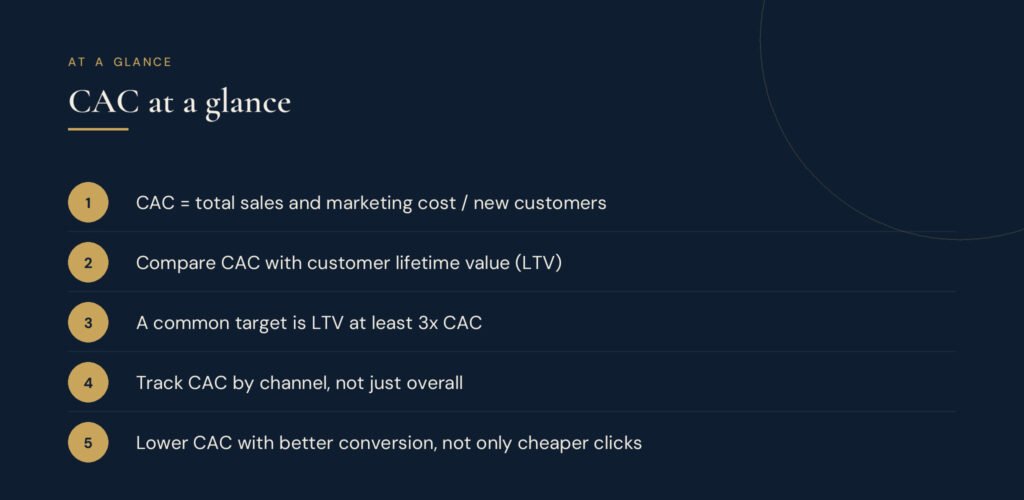
CAC = total sales and marketing costs ÷ number of new customers
Use the same time period for both numbers, usually a month or a quarter.
| Item | Example (one quarter) |
|---|---|
| Ad spend (Google and Meta) | $6,000 |
| Marketing tools and software | $600 |
| Freelance designer and copywriter | $2,400 |
| Share of team time on sales | $3,000 |
| Total cost | $12,000 |
| New customers won | 80 |
| CAC | $150 |
If you only divide ad spend by customers, you get a much lower number ($75 here) and a false sense of comfort. Ad-only CAC is useful for comparing campaigns, but the full figure is what tells you if the business model works.
Is your CAC too high? Compare it with lifetime value
A CAC of $150 is neither good nor bad on its own. It depends on how much a customer is worth to you over time, known as customer lifetime value (LTV).
A simple way to estimate LTV:
LTV = average order value × purchases per year × years as a customer × gross margin
For example, a customer who spends $80 per order, buys 4 times a year, stays for 2 years, at a 50% gross margin, is worth about $320 in gross profit.
A widely used rule of thumb is that LTV should be at least three times CAC. In the example above, $320 ÷ $150 is roughly 2.1, which suggests the business is paying too much to acquire customers or not keeping them long enough.
Two other checks are helpful:
- Payback period: how many months of gross profit it takes to earn back your CAC. Shorter is safer, especially for small businesses with limited cash.
- CAC trend: a rising CAC over several months is an early warning that a channel is saturating or your messaging is weakening.
Calculate CAC by channel
Your overall CAC hides big differences between channels. Search ads, social ads, referrals, SEO and email all cost different amounts per customer. Track new customers by source using UTM links and your analytics, then calculate CAC for each channel.
You will often find that one channel brings customers at half the cost of another. That is where the next pound or dollar should go. Our free UTM link builder makes tagging campaign links quick, and the ROI calculator helps compare returns.
Seven ways to lower customer acquisition cost
- Improve your conversion rate. If your website converts 2% of visitors instead of 1%, your CAC from paid traffic roughly halves. Clear headlines, fast pages and a single obvious call to action do more than cheaper clicks.
- Tighten targeting. Exclude audiences and search terms that click but never buy. Review search term reports and placement reports every week.
- Use retargeting. People who already visited your site are cheaper to convert. Read our guide to retargeting ads.
- Invest in organic channels. SEO and content take longer, but customers from organic search usually cost far less over time. Start with our SEO basics for small businesses.
- Ask for referrals. Happy customers are the cheapest acquisition channel. Make referring easy and reward it.
- Follow up faster. Leads contacted within minutes convert far better than those contacted the next day.
- Increase lifetime value. Sometimes the answer is not lowering CAC but raising LTV through repeat purchases, upsells and better retention.
Common CAC mistakes
- Counting only ad spend and ignoring tools, fees and team time.
- Mixing time periods, such as one month of spend with three months of customers.
- Judging a channel too early, before its sales cycle has finished.
- Optimising for cheap leads rather than paying customers.
The bottom line
Customer acquisition cost turns marketing from a cost into an investment you can measure. Calculate it honestly, compare it with lifetime value, and track it by channel. Then spend more where customers are cheapest to win and fix the leaks where they are not.
If you would like help working out your real CAC and where to improve it, request a free digital presence audit. To learn the fundamentals yourself, take the free Google and Meta Ads course at Sayf & Co. Academy.