ChatGPT can write a week of social posts in a minute. The problem is that most of what it writes sounds the same as everyone else's. The difference between bland AI copy and genuinely useful drafts is almost always the prompt.
Below are 50 ChatGPT prompts for marketing, grouped by task, that you can copy and adapt. They work just as well in Claude, Gemini or other AI assistants. First, a simple formula that makes any prompt better.
The formula behind a good marketing prompt
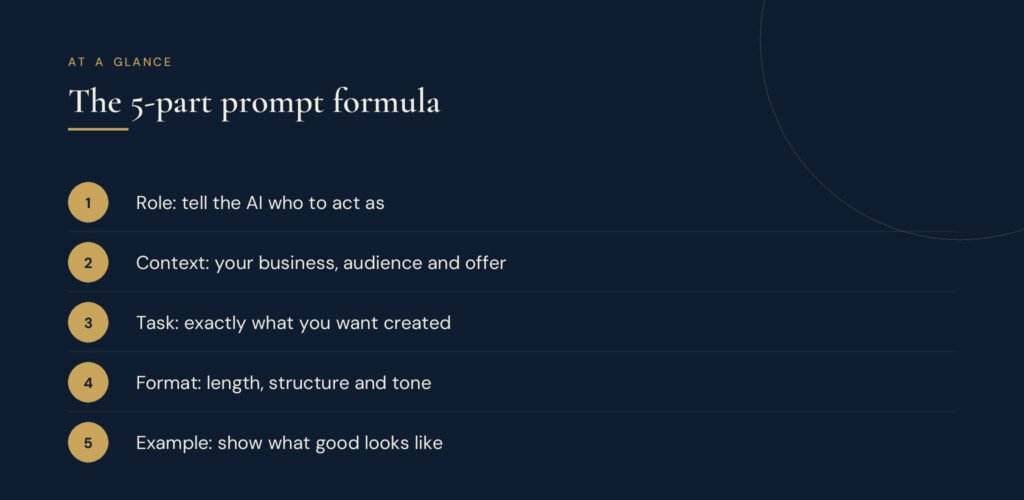
Good prompts give the AI the same brief you would give a human freelancer. Include five things:
- Role. "Act as an experienced B2B copywriter."
- Context. Who your business is, who the customer is, what you sell and why it is different.
- Task. Exactly what you want: "Write five subject lines for our spring sale email."
- Format. Length, structure, tone and any rules: "Under 50 characters, no emojis, friendly but not pushy."
- Example. If you have a post or email you like, paste it in and say "match this style."
Save a short paragraph describing your business, audience and tone of voice, and paste it at the start of every prompt. In the prompts below, replace anything in [brackets] with your own details.
Content ideas and planning prompts
- "Act as a content strategist. My business is [business], serving [audience]. List 20 blog post ideas that answer real questions my customers ask before buying. Group them by stage: awareness, consideration, decision."
- "Give me 10 content ideas for [audience] that are not about our product but would make them trust us more."
- "Create a 4-week social media content calendar for [business] with 3 posts per week. Include the post idea, format (carousel, video, single image) and goal for each."
- "What are the 15 most common objections customers have before buying [product]? For each, suggest a piece of content that answers it."
- "Turn this blog post into 5 social posts, 1 email and 3 short video ideas: [paste post]."
- "Suggest 10 seasonal content ideas for [business] for the next three months, linked to holidays and events relevant to [audience]."
Social media prompts
- "Write 5 Instagram captions for [product] aimed at [audience]. Start each with a hook under 10 words, keep them under 120 words, and end with a question to encourage comments."
- "Write a LinkedIn post from the founder of [business] sharing a lesson learned about [topic]. Use short paragraphs, no hashtags in the body, and a clear takeaway."
- "Give me 10 hook lines for short videos about [topic] that create curiosity without being clickbait."
- "Write a script for a 30-second Reel explaining [tip]. Include on-screen text, what to show in each shot and a call to action."
- "Suggest 20 relevant hashtags for a post about [topic], mixing broad, niche and community hashtags."
- "Rewrite this caption to sound more [friendly / expert / playful]: [paste caption]."
- "Write 5 replies to this customer comment that are helpful, warm and on-brand: [paste comment]."
For quick help with captions and hashtags, you can also try our free AI caption generator and hashtag generator.
Advertising prompts
- "Act as a direct-response copywriter. Write 5 Facebook ad variations for [product] targeting [audience]. Each should have a hook, one benefit and a call to action. Primary text under 125 characters."
- "Write 10 Google Ads headlines (max 30 characters) and 4 descriptions (max 90 characters) for [service] in [market]."
- "List 10 different angles for advertising [product]: price, speed, quality, fear of missing out, social proof and so on. Write one headline for each."
- "Here is my landing page copy: [paste]. Act as a conversion rate expert and list the 10 changes most likely to increase sign-ups."
- "Write 3 versions of an ad for people who visited our website but did not buy. Address the most likely reason they hesitated."
- "Create a simple A/B test plan for our next ad campaign, with what to test first and how long to run each test."
Check the length of your ad copy with our Google Ads character counter before you paste it into the ad platform.
Email marketing prompts
- "Write a 3-email welcome sequence for new subscribers to [business]. Email 1 delivers the freebie, email 2 tells our story, email 3 introduces our main offer."
- "Write 10 subject lines for an email about [topic]. Keep them under 50 characters and avoid spam trigger words."
- "Rewrite this email to be shorter and clearer, with one call to action: [paste email]."
- "Write a win-back email for customers who have not bought in 6 months. Friendly, not desperate, with a reason to come back."
- "Write a product launch email for [product], focusing on the problem it solves rather than its features."
- "Suggest 5 ideas for a monthly newsletter for [audience] that people would actually look forward to."
SEO and website prompts
- "List 30 long-tail keywords that [audience] might search when looking for [product or service]. Group them by search intent."
- "Create a detailed outline for a blog post targeting the keyword [keyword]. Include an H1, H2s, H3s, and the questions each section should answer."
- "Write a meta title (under 60 characters) and meta description (under 155 characters) for a page about [topic]."
- "Write 8 FAQ questions and short answers for our [service] page, based on what customers usually ask."
- "Rewrite this paragraph in plain English for a reader with no technical background: [paste]."
- "Suggest internal links for this article from this list of our pages: [list pages] [paste article]."
- "Write the homepage headline and subheading for [business]. Give me 5 options: one benefit-led, one problem-led, one bold, one simple and one with a number."
Test your titles in our free SERP preview tool and generate tags with the meta tag generator.
Strategy and research prompts
- "Create a detailed buyer persona for [business] including goals, frustrations, buying triggers, objections and where they spend time online."
- "Do a SWOT analysis for [business] based on this information: [paste details]."
- "What questions should I ask customers in an interview to understand why they chose us over competitors?"
- "Summarise these customer reviews into the top 5 things people love and the top 5 complaints: [paste reviews]."
- "Suggest 5 ways [business] could stand out from competitors who all claim [common claim]."
- "Help me write a one-sentence positioning statement for [business] using this structure: For [audience] who [need], we are the [category] that [benefit] because [proof]."
- "Create a 90-day marketing plan for a small business with a budget of [budget] that wants [goal]."
- "List the key metrics I should track for [channel] and what each one tells me."
Sales and customer prompts
- "Write a short, polite follow-up message for a prospect who has not replied to my proposal in a week."
- "Turn this list of product features into customer benefits: [paste features]."
- "Write a case study outline based on these notes about a client project: [paste notes]."
- "Write a script for answering the objection 'it's too expensive' for [service]."
- "Write a friendly message asking happy customers for a review, with a direct link."
- "Write 3 versions of an 'about us' paragraph: one short, one personal, one professional."
Prompts to improve AI output
- "Ask me 5 questions about my business before you write anything, so your answer is specific to us."
- "Critique the draft you just wrote as a tough editor. Then rewrite it fixing every issue."
- "Make this sound less like AI: remove clichés, vary sentence length and use plain words."
- "Give me three very different versions so I can choose a direction."
A few rules for using AI in marketing
- Treat output as a first draft. Check facts, figures and claims. AI tools can state wrong information confidently.
- Add what only you know. Real examples, customer stories, opinions and data are what make content worth reading, and what search engines reward.
- Keep private data out. Do not paste confidential customer information into public AI tools.
- Keep your voice. Edit until it sounds like your brand, not a template.
Want a deeper look at where AI fits in your marketing? Read our guide to AI for small business marketing.