
Search is changing. Instead of ten blue links, people increasingly get a written answer from ChatGPT, Perplexity, Gemini or Google's AI Overviews, often with a few sources cited underneath.
For a small business, the question is simple: when someone asks an AI tool about the problem you solve, will your business be part of the answer? You cannot control that directly, but you can make your website much easier for these tools to find, understand and trust.
How AI search finds its answers
Most AI assistants that answer questions about current topics search the web, read a handful of pages and summarise them. Google's AI Overviews draw on pages from Google's own index. In both cases, the pages that get used tend to be easy to crawl, clearly structured and directly answer the question asked.
That means good SEO is still the foundation. AI search optimisation, sometimes called AEO or GEO, builds on it rather than replacing it. If you are new to this, start with our SEO basics for small businesses.
7 steps to improve your chances
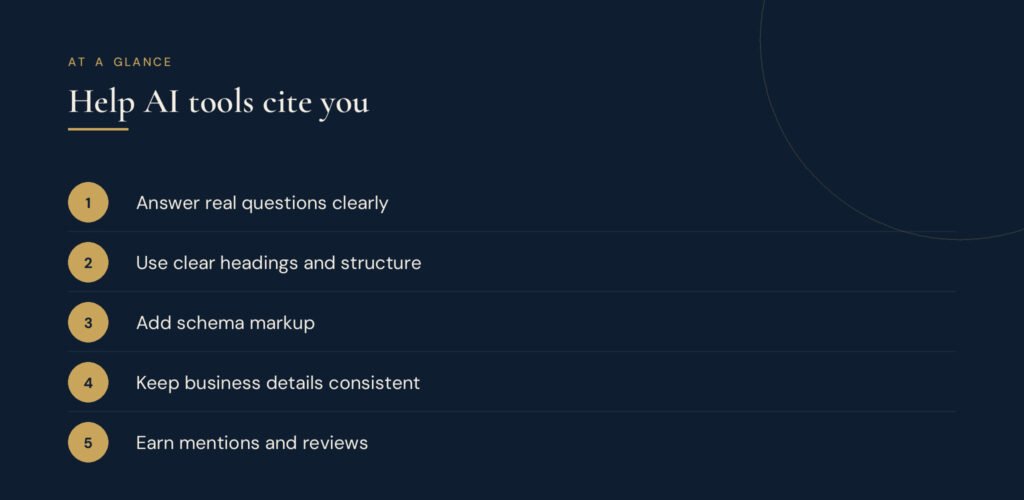
- Answer real questions directly. Put a clear, two or three sentence answer near the top of each page, then go into detail. AI tools look for passages they can quote.
- Use descriptive headings. Write headings as questions or clear statements, such as How much does a logo cost?, so each section stands on its own.
- Add structured data. Schema markup for your organisation, articles, FAQs and services helps machines understand what each page is about.
- Keep your business details consistent. Name, services, location and contact details should match across your website, Google Business Profile and directories.
- Show real expertise. Author names, case studies, original examples and clear dates make your content more trustworthy than generic text.
- Earn mentions on other sites. Reviews, interviews, guest articles and industry listings give AI tools more sources that confirm who you are. Our guide to earning backlinks applies here too.
- Let AI crawlers in. Check that your robots.txt and security settings do not block the crawlers of the AI tools you want to appear in.
What not to do
- Do not publish large volumes of thin AI-written pages; quality signals still matter. See how to use AI to write blog posts without losing quality.
- Do not stuff pages with keywords or fake FAQs.
- Do not expect instant results; AI answers change often and are hard to track.
How to check your progress
Ask the main AI assistants the questions your customers ask and note whether your business or pages appear. Do this monthly with the same questions, and watch referral traffic from AI tools in Google Analytics.
See it in practice
We structure every article on this blog with clear answers, headings and schema. Read the case study: Building an SEO content engine for sayfandco.com.
Want your content ready for AI search?
Our content and SEO service audits your pages for both search engines and AI assistants. Contact us to start.